- Regular
- $19.99
- Sale
- $19.99
- Regular
- $19.99
Sold Out
- Unit Price
- per
Liquid error (snippets/snip-product-variants line 28): product form must be given a product
Free shipping on Canadian orders over $150
Shop now, pay later with Afterpay

You got pierced. You survived the pinchy pinchy and the swelling. Things are looking pretty good.
It's been 6 or so weeks and your piercer had told you to come back and downsize your jewelry around this time.
But what exactly does that mean? And if your piercing feels fine, do you really need to do it?
In most cases: yes.
Downsizing is an annoying but necessary part of properly healing a piercing, especially a cartilage piercing.
Don't test me Susan. I know you're trying to sleep on it.
That extra-long post you left the studio with was there for a reason (the big ole swell), but it isn't meant to stay there forever.
Here's what you need to know.
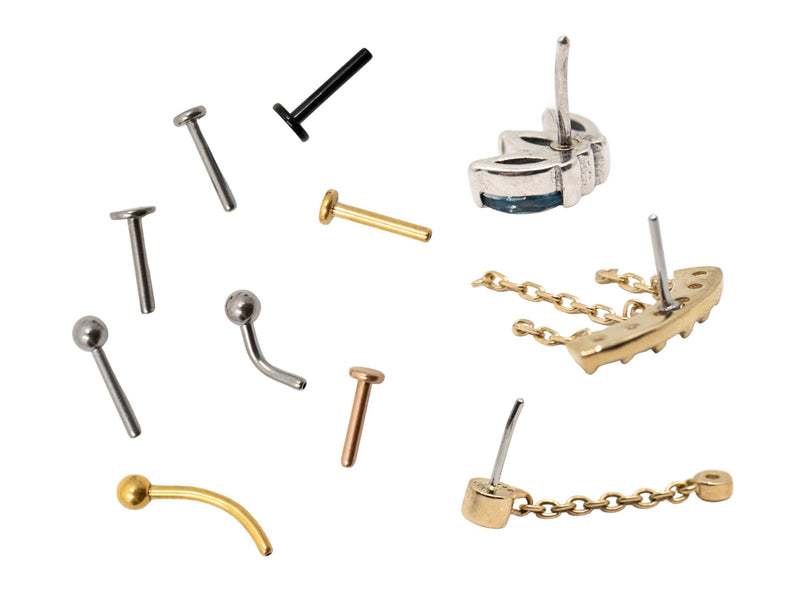
Downsizing simply means replacing the longer post used for your initial piercing with a shorter, better-fitting post once your swelling has subsided.
The good news: you can keep your decorative end, we just swap the titanium posts.
When we perform a fresh piercing, we anticipate swelling - some places swell more than others (i.e. lobes typically swell less than cartilage).
Putting perfectly fitted jewelry into a brand-new piercing could leave nowhere for that swelling to go (cue; absorption *clutches pearls*). Instead, your piercer selects a post with some additional length to safely accommodate those first stages of healing.
Think of it as temporary breathing room.
Once you don't need that extra room anymore, however, the longer post can start working against you (B.S., I know...).
A post that's too long has room to move.
It can slide back and forth through the piercing channel, catch on hair, snag on clothing and towels, get bumped more easily and generally cause a lot more crap than necessary.
And cartilage piercings can be particularly unforgiving.
Constant movement and pressure from an overly long post can contribute to irritation and may affect the angle at which your piercing heals.
It can even cause the jewelry to get knocked out, leaving you in a panic on how to keep the channel open.
Once a piercing channel has healed at an incorrect angle, simply changing to shorter jewelry later on isn't going to make that channel straight again - that ship has sailed.

That's why downsizing isn't just about making your jewelry look better.
It's about giving your piercing a more stable environment in which to finish healing.
The easiest thing to look for is visible room on the post.

Once your initial swelling has gone down, you may start noticing a portion of the bar between your ear and either end of the jewelry.
Your jewelry may also begin moving around more than it did initially.
Those are both signs that it's probably time to have your piercing downsized.
Every piercing and every person heals differently. When you book a downsize, we'll check the piercing, assess the remaining swelling and determine whether a shorter post is appropriate.
This part is important.
If your jewelry is still sitting snug against your ear and there is no visible room on the post, you are not ready to squeeze a shorter post in there.
Your piercing may still be swollen.
Putting in jewelry that's too short can create pressure and leave inadequate room for normal fluctuations in swelling.
We don't want to downsize simply because a certain number of weeks has passed.
We downsize when your piercing is ready.
Your timeline is a guide. Your ear gets the final say.
For many piercings, we recommend having your jewelry dowjnsized at approximately 6–8 weeks after your initial appointment.
That doesn't mean every piercing will be downsized at exactly six or eight weeks.
Some people are ready sooner. Others need longer.
The piercing location, your anatomy, how much you initially swelled, whether you've bumped or slept on the piercing, how many piercings you had done in a certain area and how your body heals can all affect the timing.
This is why we'd much rather take a quick look than have you guess.
Downsizing is particularly important for piercings initially fitted with additional post length to accommodate swelling.
That commonly includes piercings such as:
Helix • Flat • Forward Helix • Conch • Tragus • Lobes
Other placements and jewelry styles may have different requirements, so your piercer can tell you whether downsizing applies to your particular piercing.
Sometimes nothing, often something.
Leaving unnecessarily long jewelry in place increases the opportunity for movement, snagging and pressure.
You may notice your jewelry:
• catches constantly in your hair
• gets hooked on towels or clothing
• moves back and forth through the piercing
• sticks out noticeably
• gets knocked around more easily
• becomes irritated repeatedly
And depending on the placement, excessive movement or pressure can contribute to irritation bumps or changes in the piercing angle.
Basically, that long post was very helpful when your ear was swollen.
Now it may just be overstaying its welcome.
Heck nah, brother.
This is probably the biggest misconception about downsizing.
A piercing can be ready for a shorter post long before it is fully healed (think months, maybe gasp years).
Piercings heal from the outside in. The exterior may look completely normal while the tissue inside the piercing channel is still developing.
So while downsizing is a positive milestone, it is not permission to start changing your jewelry whenever you feel like it.
Your piercing is still healing.
If you mess with it before it's healed, I'll find you.
For most people, downsizing is quick and relatively uneventful.
Your piercing will likely still be tender because it isn't fully healed yet.
Having a piercer perform the change also means we can minimize unnecessary movement and make sure the new post is appropriately fitted to your anatomy.
And no, tighter isn't necessarily better.
We want properly fitted jewelry, not jewelry squished against your ear.
Technically, threadless jewelry is designed to come apart.
That doesn't mean we recommend standing over your bathroom sink experimenting with a healing cartilage piercing.
Changing jewelry too early can irritate the piercing channel, and choosing the wrong post length can create an entirely new problem.
During a professional downsize, we can also check your piercing angle, swelling, jewelry fit and overall healing progress. I've seen lots of instances where we had to pull cartilage piercings at the downsize because the angles were already F'ed due to sleeping on the piercing, other pressure (i.e. masks, helmets, headphones) or trauma.
So especially during healing, let us handle this one.
There will be plenty of time to play with your jewelry later.
Healing isn't always linear.
Piercings can temporarily swell again after being bumped, slept on, snagged or otherwise irritated.
If your downsized jewelry suddenly feels tight, starts pressing into the tissue or looks like it may be embedding, don't wait it out.
Come see us so we can assess whether you temporarily need a longer post again.
Jewelry should never be painfully tight or disappear into the tissue.
One of the easiest ways to understand downsizing is this:
Fresh piercing: Extra room is good.
Swelling has subsided: Extra room can become a problem.
No room on the post yet: Don't downsize.
Visible extra post: It's time for a downsize.
Your initial jewelry was selected for swelling and anatomy.
Downsizing adjusts that jewelry for the stage your piercing is at in healing.
You don't need to measure your post, diagnose your swelling or try to figure it out from photos on the internet.
If you're around the 6–8 week mark or you've started noticing extra room on your jewelry, book a piercing check with one of our piercers.
We'll look at your piercing, check the fit and let you know whether it's time to downsize - and if there's still no room on that bar, we'll tell you to wait.
Because the goal isn't to downsize as quickly as possible.
The goal is to downsize at the right time.